Yugcharan News / 21-09-2026
US President Donald Trump has warned Iran that Washington is approaching a critical decision point in the ongoing conflict, while Tehran has threatened a forceful response to any renewed American attack and said the Strait of Hormuz will remain closed unless its conditions are met.
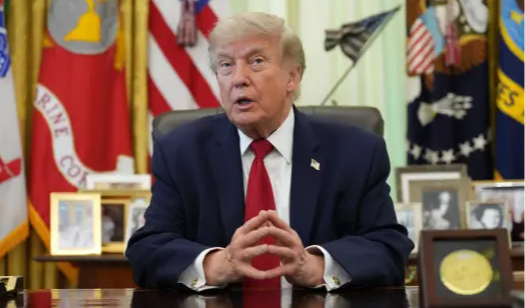
Trump made the remarks in an interview with Fox News on Sunday, September 20, as tensions between Washington and Tehran remained high and reports indicated that the United States and regional allies were preparing for possible renewed military operations against Iran.
Asked about his approach to the conflict, Trump said, “My question is, if and when do I blow the entire nation up? They had better behave.” He also said that the United States had several options, including military action, economic pressure or pursuing a diplomatic agreement.
The comments came as both sides continued to exchange warnings while leaving open the possibility of negotiations. Trump said that “very big things” could happen in the near future and indicated that he was “probably” open to meeting Iranian President Masoud Pezeshkian during the upcoming United Nations General Assembly.
The developments have placed diplomacy and military escalation alongside each other as competing possibilities in the latest phase of the US-Iran confrontation.
Trump Says Major Decision Is Approaching
In his Fox News appearance, Trump described the situation as one in which the United States was weighing different courses of action. His remarks included the possibility of imposing further economic pressure, pursuing an agreement or taking more severe military measures.
The US president's comments came at a particularly sensitive moment, with the conflict already having wider consequences for the Middle East and international shipping. Reuters reported on September 20 that tensions had escalated further after renewed hostilities and that the Strait of Hormuz and Bab el-Mandeb had become central to the wider regional crisis.
Trump's remarks also coincided with the approach of the UN General Assembly's high-level week, where leaders and senior officials from around the world are expected to gather in New York.
The possibility of direct contact between Trump and Pezeshkian has therefore emerged alongside the increasingly confrontational statements from both governments. Trump indicated that he would probably be open to a meeting with the Iranian president, although no agreement on such a meeting was announced in the material cited.
The combination of military warnings and references to diplomacy reflects the uncertainty surrounding the next phase of the conflict.
Iran Warns Against a New US Attack
Iran has responded to reports of possible renewed US military action with its own warnings.
Iran's military command said that any new American attack would be met with retaliation without limitations or considerations, according to reports cited by The Times of India.
The warning comes as Tehran says it is prepared to continue military resistance while simultaneously pursuing negotiations through intermediaries.
Iranian Parliament Speaker Mohammad Bagher Ghalibaf has repeatedly presented the two approaches as interconnected rather than mutually exclusive. Addressing parliament, he said Iran must both fight and negotiate, with military action and diplomacy being used at different stages.
“We believe that the duality of war or negotiation is not real, but that we must both fight and negotiate,” Ghalibaf said, according to the report.
He described Tehran's diplomatic position as clear and non-negotiable and said Iranian conditions had already been communicated to the other side through mediators.
The comments were also reported by other international outlets. The Associated Press and Reuters-linked reporting have described Tehran's position as involving both military resistance and diplomatic efforts, while Iran continues to insist that Washington must meet its conditions before negotiations can return to previous terms.
Seven Conditions Communicated Through Qatar
A major point in the latest diplomatic exchanges is a set of seven conditions that Iran has communicated to the United States through Qatari mediators.
According to reports, Tehran has presented the conditions as a possible basis for negotiations aimed at ending the conflict. Iranian officials have said that Washington's response is awaited.
The precise seven-point list has not been publicly released in full by the Iranian government in the material reviewed for this report. However, reports have identified several of the demands, including an end to the war, the lifting of the naval blockade and measures involving frozen Iranian funds and US sanctions.
Al Jazeera reported that Iran's conditions include an end to the naval blockade on Iranian ports, an end to US interference in Iran's internal affairs, an end to US attacks on Iranian territory and an end to US cooperation with opponents of the Iranian government.
The demands have become closely linked to the future of the Strait of Hormuz, one of the world's most important maritime passages for energy shipments.
Iran has made clear that it does not intend to return the waterway to its previous status unless its conditions are fulfilled and commitments from Washington are implemented.
Strait of Hormuz Becomes Key Pressure Point
The Strait of Hormuz has emerged as one of the central issues in the confrontation.
Ghalibaf said Iran would not reopen the strategic waterway until its conditions were satisfied and US commitments were implemented. He said there would be no return to the previous negotiating framework or reopening of the strait until Tehran's stated requirements were addressed.
The waterway connects the Persian Gulf with the Gulf of Oman and is a critical route for international energy trade. Any prolonged disruption can therefore have implications well beyond the immediate US-Iran confrontation.
Iran's position has raised concerns over shipping and energy supplies, particularly as tensions have also affected other maritime routes in the region.
Reports on September 20 said Iranian officials had conveyed their conditions through mediators and were waiting for Washington's response. Gulf Today separately reported that Tehran had communicated conditions for ending its blockade of the strategic waterway.
The dispute over Hormuz has consequently become both a military and diplomatic issue. Iran is using the reopening of the waterway as part of its stated conditions, while the United States and its regional partners are dealing with the wider consequences of restrictions on maritime traffic.
Tehran Uses ‘Decisive War’ Warning
Iranian officials have also used increasingly strong language in describing what could happen if the United States rejects its conditions.
Mohsen Rezaei, secretary of Iran's Supreme National Security Council, was reported as saying that Tehran was awaiting a response from Washington. Other Iranian officials have warned that rejection of the demands could lead to what they describe as a “decisive war.”
The language reflects the increasingly confrontational nature of statements from both sides, although Iranian officials have continued to leave open the possibility of negotiations.
The Tribune, citing ANI, reported that Iran had conveyed seven conditions through Qatari mediators and warned that it was prepared for a “decisive war” if Washington rejected them.
At the same time, Ghalibaf has argued that military action and diplomacy should operate together. His statements indicate that Tehran does not view negotiations as a substitute for military preparedness.
UN General Assembly Adds Diplomatic Dimension
The timing of the latest statements is significant because the United Nations General Assembly's high-level week begins in New York.
Trump's indication that he may be willing to meet Pezeshkian creates a possible diplomatic channel even as the military rhetoric remains intense.
Such a meeting, if it takes place, would come against the backdrop of extensive disagreement over the conditions for ending hostilities, sanctions, maritime restrictions and the future of the Strait of Hormuz.
No confirmed agreement for a Trump-Pezeshkian meeting was included in the reports reviewed. Trump's statement only indicated that he would probably be open to talks.
The United Nations gathering could nevertheless provide an opportunity for indirect or direct diplomatic contacts involving the United States, Iran and other countries seeking to contain the conflict.
Regional Conflict Continues to Broaden
The confrontation between Washington and Tehran is also unfolding alongside attacks and military activity involving other actors in the Middle East.
Reuters reported that Iran-backed Houthi forces had intensified attacks in the region, including strikes involving Saudi Arabia, while the disruption of important maritime routes was adding pressure to the wider security situation.
The Strait of Hormuz is particularly important because of its role in global energy transportation. Continued restrictions or further military escalation in the surrounding waters could affect shipping routes and energy markets.
For governments in the Gulf and other countries dependent on energy imports, developments around the waterway are therefore being closely monitored.
The latest exchange of threats also comes after months of confrontation between Iran and the United States. Reuters reported that the conflict followed US and Israeli strikes that began on February 28 and that a June ceasefire agreement subsequently broke down.
What Happens Next
The immediate focus is likely to remain on whether Washington responds to Tehran's conditions and whether diplomatic contacts can progress during the UN General Assembly.
Trump has publicly kept several options open, ranging from negotiations to stronger economic or military action. Iran, meanwhile, has said that it is prepared to continue fighting while maintaining a diplomatic channel through mediators.
The two positions remain far apart on several central issues, including military operations, sanctions, maritime restrictions and the conditions for reopening the Strait of Hormuz.
For now, there is no indication in the reports reviewed that a comprehensive settlement has been reached.
The latest statements instead point to a period in which military threats and diplomatic efforts are continuing simultaneously. Trump's warning and Iran's threat of a “decisive war” underline the seriousness of the confrontation, while the possibility of a meeting between Trump and Pezeshkian suggests that diplomacy has not been completely ruled out.
The coming days, particularly during the UN General Assembly's high-level meetings, could therefore bring further statements, negotiations or changes in the military situation. The precise direction remains dependent on decisions by Washington, Tehran and the other governments involved in the wider regional conflict.