Yugcharan News / 16-09-2026
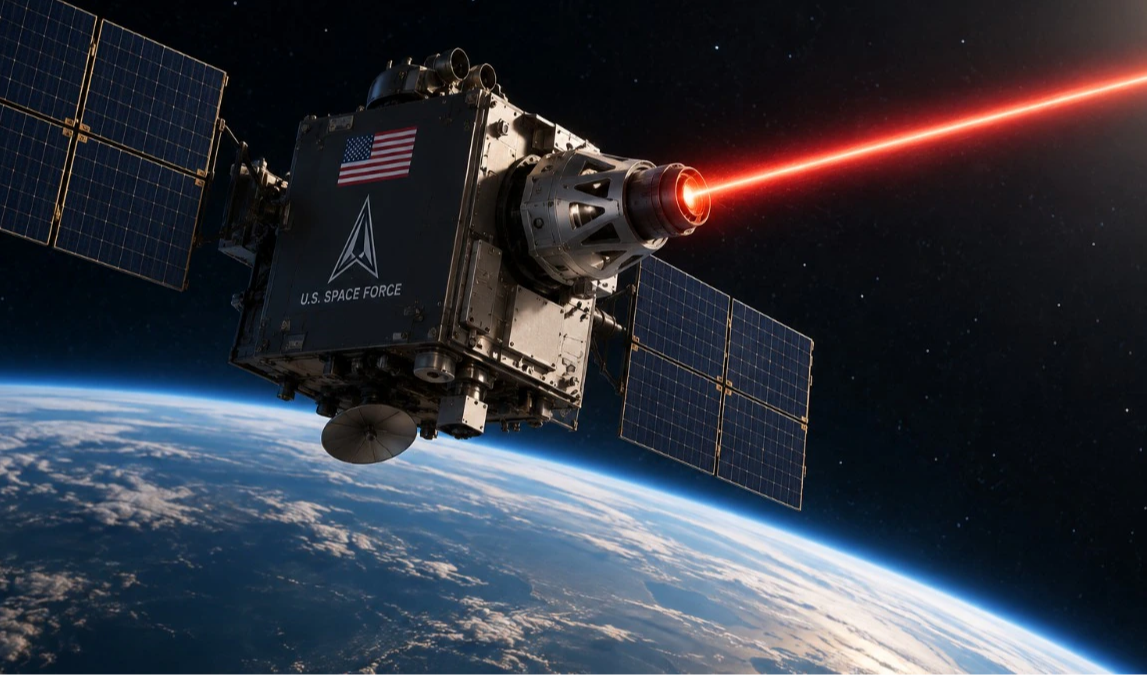
The United States has publicly acknowledged for the first time that it has deployed offensive weapons capable of operating in space, marking a significant development in the growing militarisation of the space domain. The US Space Force confirmed that Washington possesses “on-orbit” space-control weapons designed to protect American military forces and counter hostile activities in space.
The disclosure was made as the United States continues to expand its military capabilities beyond Earth and strengthen its preparations for a new era of strategic competition with China and Russia. US Air Force Secretary Troy Meink announced the development during the annual Air, Space, and Cyber Conference at National Harbor in Maryland, where he indicated that the newly acknowledged capabilities were intended to respond to evolving threats in orbit.
However, US officials did not provide details about the exact nature of the weapon or weapons currently deployed. The lack of technical information has left open questions about whether the system is designed to physically disable satellites, interfere with their operations, disrupt communications or perform another form of military action.
According to the US Space Force, the capabilities form part of a broader “space control” mission. A spokesperson said the United States has on-orbit weapons capable of defending the Joint Force against hostile actions by adversaries. The statement also indicated that such capabilities can be used for both defensive and offensive purposes.
The announcement represents an important shift in the way the United States is publicly discussing military operations in space. For decades, Washington and other major powers have acknowledged the strategic importance of space-based assets, but governments have generally been cautious about openly discussing offensive weapons deployed in orbit.
Space becomes a growing military battlefield
Space has played a central role in military operations for decades. Modern armed forces rely heavily on satellites for communications, navigation, intelligence gathering, surveillance, missile warning systems and other functions. As a result, disabling an opponent’s satellites could potentially affect military operations on Earth.
The competition over space capabilities dates back to the early years of the Cold War. The launch of the Soviet Union’s Sputnik satellite in 1957 triggered a technological and strategic race between Moscow and Washington. Both countries subsequently developed increasingly sophisticated space programmes, while military planners began considering how satellites could be used in future conflicts.
The 1967 Outer Space Treaty established important restrictions on military activity in space. Among other provisions, the treaty prohibits countries from placing nuclear weapons or other weapons of mass destruction in orbit around Earth. It also establishes principles governing the peaceful use of outer space.
The treaty, however, does not impose a complete ban on all military activity in space. Conventional military satellites are widely used by major powers, while countries have continued to develop technologies capable of disrupting, disabling or destroying space-based systems.
This has created a complex security environment in which governments can operate military systems in space while remaining within the framework of international agreements.
Washington points to threats from China and Russia
The US announcement comes as Washington increasingly identifies China and Russia as major strategic competitors in space.
The US Space Force has described China as developing and operating space and counterspace capabilities as part of its broader military modernisation programme. Counterspace capabilities generally refer to technologies and systems that can interfere with, disrupt or otherwise affect an adversary’s space-based assets.
Russia has also been described by the United States as viewing space as an important military domain. American officials have repeatedly warned that Moscow could seek to challenge US satellite systems during a major conflict.
The growing dependence of modern militaries on satellites has made space security a major component of national defence planning. A disruption to navigation or communication satellites, for example, could affect military operations over large geographic areas.
China, Russia and the United States have all invested heavily in space technology, including satellites, launch systems, surveillance capabilities and counterspace technologies. Other countries, including India, have also developed capabilities relevant to military space operations.
What does an ‘on-orbit’ weapon mean?
The term “on-orbit weapon” covers a potentially broad category of technologies, and the United States has not publicly disclosed the specific system it has deployed.
US officials have described the capability as part of “space control”. The term can include activities intended to protect friendly satellites, prevent an adversary from using space-based systems and disrupt hostile space operations.
Such capabilities can theoretically involve both kinetic and non-kinetic methods.
Kinetic systems physically interact with or damage a target, while non-kinetic systems can potentially interfere with an opponent’s satellite without physically destroying it. Electronic warfare, cyber operations and other forms of interference can form part of broader counterspace strategies.
The US Space Force said its capabilities can be used for offensive as well as defensive purposes. However, officials did not explain how the newly acknowledged weapon operates, how many systems are deployed or which satellites or targets they are designed to engage.
That lack of information makes it difficult to independently assess the precise military capabilities of the system.
Golden Dome programme adds to space focus
The announcement also comes as the administration of US President Donald Trump pushes ahead with the development of the “Golden Dome” missile defence initiative.
The programme is intended to strengthen US defences against ballistic missiles and other airborne threats. Space-based technologies are expected to play an important role in modern missile warning, tracking and defence networks.
The growing importance of space-based sensors means that satellites are increasingly becoming part of integrated military defence systems. Any conflict involving missiles, drones or long-range weapons could therefore also involve competition over satellites and other space infrastructure.
The United States is seeking to expand its ability to monitor threats and protect its military assets in orbit. The acknowledgment of an operational on-orbit weapon indicates that Washington is also preparing for scenarios in which adversaries could attempt to interfere with or attack American space systems.
International concerns over an arms race
The public confirmation of an offensive space weapon is likely to intensify international debate about the future of military competition beyond Earth.
Governments and security experts have long warned that the development of counterspace weapons could create a new arms race. If one country develops the ability to disable another country's satellites, rivals may respond by creating similar systems or strengthening the protection of their own space assets.
There are also concerns about the potential consequences of destroying satellites. A physical attack on a satellite could create large amounts of orbital debris, potentially threatening other spacecraft operating in the same region.
This is particularly important because space infrastructure is used not only by militaries but also by civilian governments, businesses and international organisations. Communications, weather forecasting, navigation, television broadcasting and financial systems can all depend on satellites.
A major conflict in orbit could therefore have consequences extending far beyond military operations.
A changing strategic environment
The United States' acknowledgement reflects the increasingly contested nature of outer space. Military planners no longer view space simply as a support environment for operations on Earth. Satellites and other space-based systems are themselves becoming strategic assets that countries may attempt to defend or target during a conflict.
For Washington, the stated objective is to ensure that American military forces can continue operating even if adversaries attempt to interfere with US space infrastructure. For China and Russia, the expansion of American space capabilities could be viewed as part of a broader effort to strengthen US military dominance.
The absence of detailed information about the US weapon means that many questions remain unanswered. Washington has not publicly identified the weapon's design, deployment location, operational range or specific targets. It has also not explained whether the system has previously been used in an operational situation.
Nevertheless, the announcement itself is significant because it confirms that the United States has moved beyond developing theoretical counterspace capabilities and now acknowledges having an offensive weapon operating in orbit.
As competition between major powers increasingly extends into space, the development of such systems is expected to remain a major issue for international security. The challenge for governments will be to protect critical space infrastructure while preventing the emerging competition from developing into an uncontrolled arms race.
For now, the US disclosure provides a rare public glimpse into Washington's military preparations in orbit. With China and Russia continuing to expand their own space and counterspace programmes, the strategic importance of Earth's orbital environment is likely to grow further in the years ahead.