Search

    Language Settings
    Select Website Language

    GDPR Compliance

    We use cookies to ensure you get the best experience on our website. By continuing to use our site, you accept our use of cookies, Privacy Policy, and Terms of Service.

    Parliament Monsoon Session: Lok Sabha Passes Anti-Paper Leak Amendment Bill Amid Uproar, Opposition and Government Clash Over Student Protest Issue

    17 hours ago

    Yugcharan News / 29-07-2026

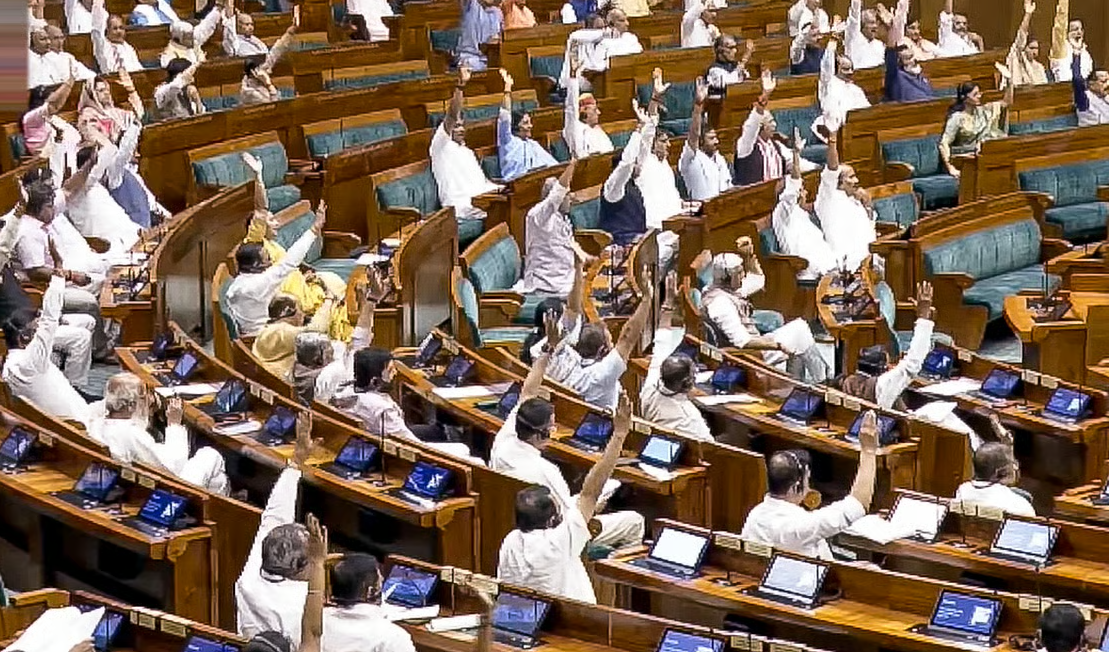
    The eighth day of the Monsoon Session of Parliament witnessed intense political confrontation, repeated disruptions, and multiple adjournments in both the Lok Sabha and the Rajya Sabha. Despite the continuous protests, the Lok Sabha successfully passed the Public Examinations (Prevention of Unfair Means) Amendment Bill, 2026 through a voice vote on Wednesday.

    The proposed legislation seeks to strengthen India's legal framework against examination malpractices by introducing stricter punishments for individuals and organized groups involved in examination paper leaks and other unfair practices. However, the debate surrounding the Bill quickly turned into a heated political exchange, with the Opposition raising concerns over the recent police action against protesting students while the government defended both its legislative measures and its response to the examination controversy.

    The proceedings throughout the day reflected the growing political divide over issues related to education, law enforcement, and accountability, resulting in repeated disruptions before both Houses were finally adjourned until Thursday.

    Lok Sabha Passes Public Examinations Amendment Bill

    The Lok Sabha passed the Public Examinations (Prevention of Unfair Means) Amendment Bill, 2026 by voice vote after an extensive discussion involving members from both the ruling alliance and the Opposition.

    The Bill is aimed at preventing examination fraud by significantly strengthening penalties against those responsible for paper leaks, organized cheating networks, and institutions facilitating examination malpractice. According to the government, the amendments were introduced after consultations with multiple stakeholders following recent controversies surrounding national-level examinations.

    Minister of State in the Prime Minister's Office, Jitendra Singh, while replying to the debate, stated that the government had carefully revised several provisions of the original legislation enacted in 2024 to make it more effective in combating organized examination fraud.

    Stricter Punishments Proposed

    During his address in the Lok Sabha, Jitendra Singh explained that the amended law substantially increases penalties for offenders.

    Under the revised provisions:

    • Service providers found guilty of facilitating examination fraud may now face fines of up to ₹5 crore, compared to the earlier maximum of ₹1 crore.
    • Directors and management personnel involved in examination-related offences may face imprisonment along with significantly higher financial penalties.
    • Individuals directly involved in paper leaks may face five to ten years of imprisonment along with fines of up to ₹50 lakh, compared to the previous punishment of three to five years and lower monetary penalties.
    • Officials responsible for conducting examinations may also face stricter legal consequences if found negligent or involved in malpractice.
    • Organized criminal networks involved in examination fraud may now face a minimum of seven years' imprisonment and fines that may extend up to ₹10 crore.

    According to the government, these enhanced provisions are intended to create a stronger deterrent against large-scale examination scams that affect millions of students across the country.

    Government Defends Its Response to NEET Paper Leak

    Responding to criticism from the Opposition, Jitendra Singh maintained that the Union Government acted swiftly following allegations surrounding the NEET examination paper leak.

    He stated that investigations were initiated promptly and emphasized that the government remains committed to ensuring transparency and fairness in all public examinations.

    The Minister also praised the implementation of the National Education Policy (NEP) 2020, saying that it has provided students with greater academic flexibility through multiple entry and exit options and interdisciplinary learning opportunities.

    According to him, the reforms under NEP have given students greater freedom to pursue their preferred fields instead of being confined to rigid educational structures.

    Rahul Gandhi Criticizes Government During Debate

    Leader of the Opposition Rahul Gandhi strongly criticized the government while participating in the debate on the Amendment Bill.

    He praised students who had recently protested over examination-related issues, describing them as individuals fighting for transparency and accountability in the education system.

    Rahul Gandhi alleged that the education system has become increasingly expensive and argued that students deserve greater protection and fairness during competitive examinations.

    During his speech, he also made allegations regarding the police action taken against student protesters and questioned the government's handling of the demonstrations.

    His remarks triggered immediate protests from members of the ruling party, resulting in loud sloganeering inside the House.

    Heated Exchange in the House

    The debate intensified after Rahul Gandhi made remarks concerning Union Home Minister Amit Shah and alleged excessive use of force against protesting students.

    The statements prompted strong objections from treasury bench members.

    Parliamentary Affairs Minister Kiren Rijiju demanded clarification regarding the allegations and urged Rahul Gandhi to apologize for remarks that the government described as inappropriate and unsupported.

    Defence Minister Rajnath Singh also requested that certain expressions used during the debate be removed from the official parliamentary records, arguing that they were not in keeping with parliamentary decorum.

    Lok Sabha Speaker Om Birla repeatedly appealed to members to maintain discipline and reminded them that parliamentary proceedings must be conducted according to established rules.

    As protests continued from both sides, the House was adjourned several times before business eventually resumed.

    Opposition Raises Concerns Over Student Protests

    Several Opposition MPs used the discussion on the Bill to raise concerns regarding the recent police action against students protesting over examination irregularities.

    Members argued that the concerns of students deserved a comprehensive discussion in Parliament and demanded greater accountability from the government.

    The Opposition also questioned whether stricter laws alone would be sufficient unless examination systems themselves became more transparent and secure.

    Throughout the day, Opposition members repeatedly sought discussions on issues related to student protests, resulting in disruptions in both Houses.

    Suggestions from Members During Debate

    Several MPs contributed suggestions during the debate on improving India's examination system.

    Independent MP Pappu Yadav emphasized that examination reforms should focus on reducing human intervention and increasing the use of technology.

    He suggested studying examination models adopted by countries such as Japan, China, and Singapore to improve transparency and efficiency.

    Kerala MP N.K. Premachandran also raised concerns regarding the handling of recent student protests and called for accountability over the events surrounding the examination controversy.

    Registration of Births and Deaths Amendment Bill Introduced

    Apart from the anti-paper leak legislation, the government also introduced the Registration of Births and Deaths (Amendment) Bill, 2026 in the Lok Sabha.

    The Bill was introduced by Minister of State for Home Affairs Nityanand Rai, adding another important legislative proposal to the ongoing Monsoon Session.

    Rajya Sabha Witnesses Repeated Disruptions

    The Rajya Sabha also experienced repeated interruptions throughout the day.

    Opposition members demanded the presence of Union Home Minister Amit Shah during discussions relating to the recent student protests and police action.

    The repeated protests led to multiple adjournments before the House reconvened later in the afternoon.

    During the post-lunch session, the Rajya Sabha briefly discussed the National Honour (Amendment) Bill, 2026. However, the debate also witnessed protests and eventually an Opposition walkout during the discussion.

    Political Tensions Continue During Monsoon Session

    The events of the eighth day of the Monsoon Session reflected continuing political tensions between the government and the Opposition over education reforms, examination integrity, and recent student protests.

    While the government maintained that the amended legislation represents a decisive step toward protecting the integrity of competitive examinations, Opposition parties argued that broader concerns regarding governance, accountability, and the treatment of protesting students also require serious parliamentary attention.


    With both Houses adjourned for the day, Parliament is scheduled to reconvene on Thursday, July 30, 2026, when discussions on pending legislation and other national issues are expected to continue.

    Click here to Read More
    Previous Article
    जंतर-मंतर प्रदर्शन से जुड़े व्यक्ति ने सुप्रीम कोर्ट का दरवाजा खटखटाया, दिल्ली पुलिस पर अपहरण और उत्पीड़न के गंभीर आरोप
    Next Article
    Delhi Police Registers FIR Over Allegedly Defamatory Social Media Posts Targeting Prime Minister, Seeks Details From X

    Related National Updates:

    Are you sure? You want to delete this comment..! Remove Cancel

    Comments (0)

      Leave a comment