Yugcharan News / 16-09-2026
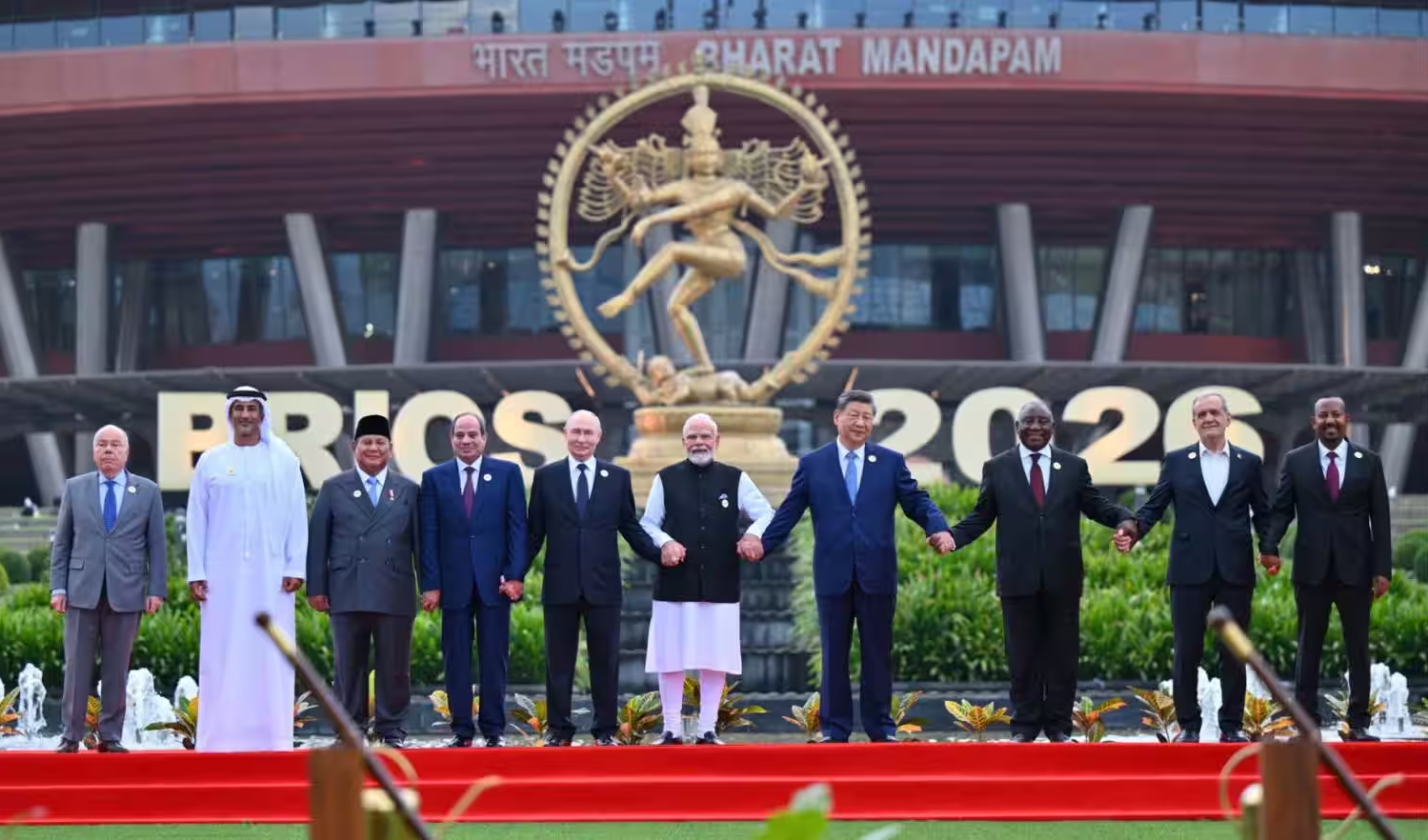
The 18th BRICS Summit, hosted by India in New Delhi, concluded with the adoption of the New Delhi Declaration, bringing together the grouping’s expanded membership around a broad range of issues including international trade, terrorism, agriculture, education, technology, health, space cooperation and reform of global institutions.
The summit, held from September 12 to 13, came at a time of heightened trade tensions, geopolitical uncertainty and growing debate over the future of the international economic order. The 45-page declaration contains a wide range of commitments and areas of cooperation, while some contentious geopolitical issues were not included in the final document.
The 2026 summit was particularly significant because BRICS marked two decades since its formation. The grouping, which began as BRIC with Brazil, Russia, India and China, has expanded substantially over the years. South Africa joined in 2010, while Egypt, Ethiopia, Iran, Saudi Arabia and the United Arab Emirates joined in 2024. Indonesia became a full member in January 2025, taking the grouping to 11 full members.
The theme of India's BRICS presidency was “Building for Resilience, Innovation, Cooperation, and Sustainability”. The New Delhi Declaration reflected that broad agenda, with substantial attention given to economic cooperation and development-oriented initiatives.
Focus on Maritime Safety and Seafarers
One of the initiatives highlighted during the summit was the proposed BRICS Seafarers’ Emergency Support Network. Prime Minister Narendra Modi proposed the mechanism with the objective of providing timely assistance and improving the safety and welfare of personnel working at sea.
Maritime security has a direct connection with global trade because a significant share of international commerce moves through sea routes. India is also a major contributor to the global maritime workforce. The proposed network therefore places the safety of seafarers within the wider BRICS cooperation framework.
The initiative comes against a backdrop of disruptions and security concerns affecting international shipping routes. A coordinated support mechanism among BRICS members could provide a platform for cooperation when seafarers face emergencies or other difficulties while operating in international waters.
Agriculture Gets Greater Attention
Agriculture was another major area of cooperation at the summit. BRICS countries announced four new agricultural initiatives, including programmes focused on agroecology, regenerative agriculture, climate resilience, productivity and digital agriculture.
The grouping also agreed to establish BRICS AGRIN, described as a collaborative, non-binding and farmer-centric network dealing with agro-inputs, genetic resources and information. The summit further welcomed the launch of a Global Forum on Farmers’ Rights in Seed Systems.
These initiatives reflect the increasing importance of food security, climate adaptation and agricultural technology. For developing economies, improving farm productivity while dealing with climate-related challenges has become an important policy concern.
The proposed mechanisms could also encourage the exchange of agricultural knowledge and technologies between BRICS members, although their eventual impact will depend on how participating countries implement the initiatives.
Mechanism Proposed to Track BRICS Decisions
The summit also addressed a recurring challenge for multilateral groupings: ensuring that declarations and agreements are followed by implementation.
India proposed a BRICS Continuity and Implementation Mechanism that would enable member countries to monitor initiatives and outcomes through the BRICS Troika. The Troika consists of the previous, current and incoming chairs of the grouping.
The mechanism is intended to provide continuity as the chairmanship changes from one country to another. Such a system could help prevent initiatives announced at one summit from losing momentum when the next chair takes over.
NIMHANS to Coordinate Mental Health Centres
Health cooperation also featured prominently in the New Delhi Declaration. BRICS members supported the creation of a network of training hubs and Centres of Excellence in mental health.
Bengaluru-based National Institute of Mental Health and Neuro Sciences, or NIMHANS, was identified as the coordinating institution for the initiative.
The inclusion of mental health in the BRICS cooperation agenda reflects the growing recognition of mental-health services as an important component of public health. The proposed network could facilitate training, knowledge exchange and cooperation among institutions across member countries.
Education and Skill Development
Education was another important component of the summit outcomes. BRICS countries called for cooperation in Early Childhood Care and Education and Foundational Literacy and Numeracy.
The declaration also highlighted technical and vocational education and training through the BRICS Technical and Vocational Education and Training Cooperation Alliance. The BRICS Network University was encouraged to consider traditional, indigenous and local knowledge systems as an additional thematic area.
The focus on vocational education is particularly relevant as BRICS economies face the challenge of preparing workers for technological changes and new industries. Cooperation in skills development could help member countries exchange approaches in technical training and workforce development.
Space Cooperation and Remote Sensing
Space technology emerged as another area of cooperation. The New Delhi Declaration recorded progress toward amending the BRICS Remote Sensing Satellite Constellation agreement to allow the participation of additional space agencies.
The existing remote-sensing network involves observation satellites operated by BRICS countries, including India's Resourcesat satellites, China's Gaofen and Ziyuan satellites and Russia's Kanopus-V series. The summit also worked on the Terms of Reference for a BRICS Space Council.
The declaration additionally emphasised space-debris mitigation and the long-term sustainability of outer-space activities.
A stronger satellite cooperation framework could help member countries collaborate in areas such as environmental monitoring, agriculture, disaster management and other applications that rely on Earth-observation data.
Science and Research Cooperation
The summit also backed the planned BRICS Science and Research Repository. The proposed platform is intended to facilitate voluntary knowledge sharing among member countries while taking into account data-security requirements, intellectual-property rights and national regulations.
The initiative reflects the broader push within BRICS to strengthen cooperation in science and technology. It could create additional opportunities for researchers and institutions to exchange information and collaborate on areas of common interest.
Trade, Tariffs and WTO Reform
Economic issues formed a significant portion of the New Delhi Declaration. BRICS members discussed ways to make global value chains more resilient and called for the use of what the declaration describes as “mutually reinforcing policy levers” to increase trade within the grouping.
These measures include stronger regional integration, diversification beyond primary commodities, investment in physical and digital infrastructure, regulatory cooperation and development of workforce skills.
The declaration also criticised unilateral coercive measures, economic sanctions and secondary sanctions. BRICS members expressed concern over trade-restrictive measures and argued for a more open, transparent, inclusive and predictable multilateral trading system centred on the World Trade Organization.
The declaration also opposed trade measures involving carbon border adjustment mechanisms, an issue that has become increasingly important as countries introduce climate-linked trade policies.
BRICS Condemns Pahalgam Terror Attack
On terrorism, BRICS leaders reached consensus on language condemning terrorist acts regardless of their motivation or location.
The New Delhi Declaration specifically condemned the April 22, 2025 terrorist attack in Jammu and Kashmir's Pahalgam area, in which 26 people were killed and many others injured. The wording was broadly consistent with the position adopted in the previous BRICS declaration in Rio de Janeiro.
The inclusion of the Pahalgam attack was significant for India's diplomatic efforts to place terrorism among the major issues discussed by the grouping. The declaration also reiterated broader opposition to terrorism and called for international cooperation against terrorist activity.
Support for UN Security Council Reform
The New Delhi Declaration also addressed reform of the United Nations Security Council.
China and Russia, both permanent members of the Security Council, reiterated their support for the aspirations of Brazil and India to play a greater role in the United Nations, including the Security Council.
India has for years sought a larger role in the UN Security Council, arguing that the composition of the institution should better reflect contemporary global realities.
The BRICS position provides a multilateral platform for discussions around reform of international institutions, although actual changes to the Security Council would require a broader UN process.
What Was Missing From the Declaration?
While the declaration covered numerous economic and development issues, some major geopolitical subjects were absent.
Ukraine was not mentioned in the 2026 New Delhi Declaration. The document did not refer by name to the conflict, Russia's invasion or related sanctions. The omission contrasts with the 2025 Rio declaration, which had referred to members' respective national positions on the Ukraine conflict.
The absence of Ukraine highlights the difficulty of reaching consensus within a grouping that includes countries with different foreign-policy positions and relationships with the major powers.
Another subject not included was the creation of a common BRICS currency. Despite years of discussion and speculation about whether BRICS could eventually develop a shared currency, the declaration did not announce such a project.
Instead, the grouping continued to discuss greater use of members' national currencies for trade and investment. The declaration recognised that there was no single approach applicable to all members and focused on making cross-border payments more efficient while respecting national priorities.
A Broad Agenda for an Expanded BRICS
The New Delhi Summit demonstrated the increasingly broad agenda of BRICS. From agriculture and education to space technology, mental health, trade and maritime safety, the grouping is expanding cooperation beyond its original economic focus.
At the same time, the declaration showed the limits of consensus on sensitive geopolitical questions. The absence of Ukraine and a common BRICS currency illustrates how the grouping continues to rely on areas where its diverse membership can find common ground.
The 2026 summit therefore produced a combination of new initiatives, institutional mechanisms and shared positions rather than a single transformative agreement. The emphasis was largely on practical cooperation in sectors where member countries can exchange expertise, strengthen economic links and develop common frameworks.
For India, hosting the 18th BRICS Summit provided an opportunity to place issues such as seafarer safety, agricultural resilience, digital and space cooperation, education, mental health and reform of global institutions on the BRICS agenda. The effectiveness of these initiatives, however, will ultimately depend on implementation by individual member states.
The New Delhi Declaration provides the framework, but the coming years will determine whether the commitments made in the Indian capital translate into sustained cooperation across the expanded BRICS grouping.