Yugcharan News / 25-11-2026
The Bharatiya Janata Party (BJP) and the Shiromani Akali Dal (SAD) have officially revived their political alliance after a six-year separation, announcing their partnership on Tuesday, November 24, during the occasion of Gurpurab. The two parties will contest the 2027 Punjab Assembly elections together, marking a significant development in the state's political landscape as they prepare to challenge the ruling Aam Aadmi Party (AAP) and the Congress.
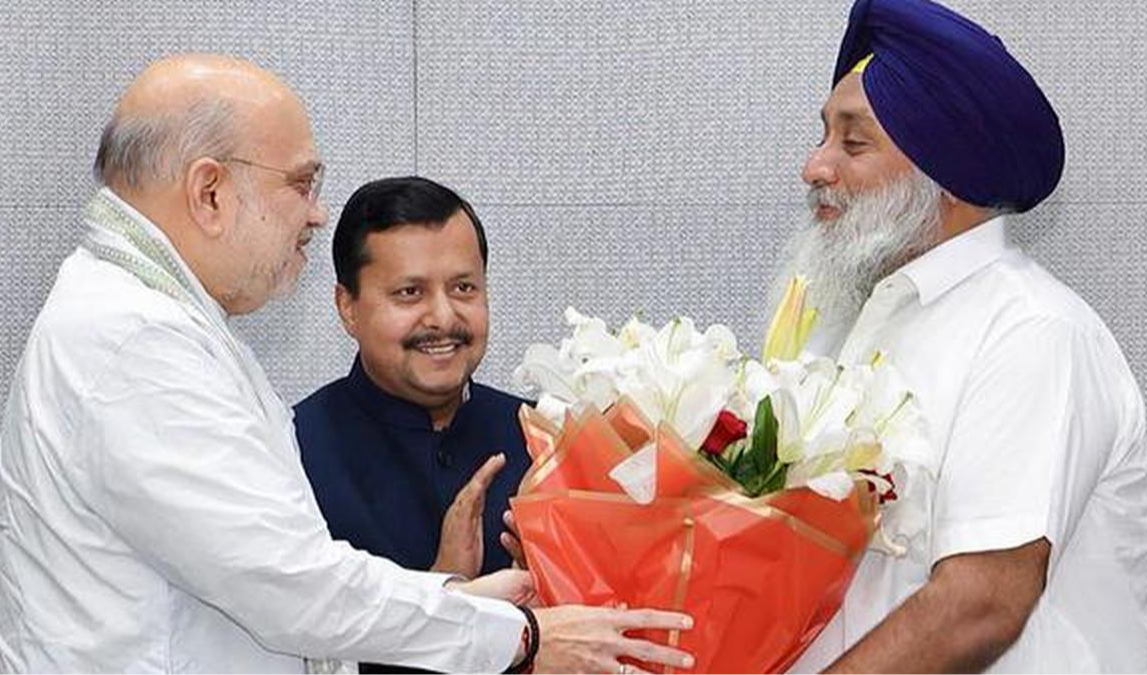
The announcement was made at a joint press conference at the BJP headquarters in New Delhi, attended by Union Home Minister Amit Shah, Shiromani Akali Dal president Sukhbir Singh Badal and BJP president Nitin Nabin. Shah described the development as the return of one of the National Democratic Alliance's (NDA) oldest political partners, expressing satisfaction over the renewed association.
The revival of the alliance comes six years after the two parties separated over disagreements surrounding the three controversial farm laws introduced by the Centre. Those laws had triggered widespread protests by farmers, particularly in Punjab and neighbouring Haryana, eventually leading to a prolonged political confrontation.
The timing of the announcement has also attracted attention because the original separation and the subsequent repeal of the farm laws were closely connected to Gurpurab. Prime Minister Narendra Modi had announced the repeal of the three agricultural laws on November 19, 2021, on the occasion of Gurpurab. Five years later, the BJP and SAD have chosen the same religious occasion to announce their political reunion.
Amit Shah Announces Akali Dal's Return to NDA
Addressing the joint press conference, Amit Shah welcomed the Shiromani Akali Dal's return to the NDA and described the development as an important moment for the alliance.
Beginning his address with greetings on Gurpurab, Shah referred to the gathering as an NDA press conference and said the Akali Dal would once again function as an officially recognised ally of the ruling national coalition.
Shah said, "From today onwards, the Akali Dal will work in politics as an officially recognised ally of the NDA."
He further highlighted the historical association between the BJP and SAD, describing the Akali Dal as one of the oldest partners of the NDA.
According to Shah, Prime Minister Narendra Modi had also spoken to Sukhbir Singh Badal and the party leadership over the phone following the development. Shah said the Prime Minister had expressed happiness about the reunion and conveyed that the NDA alliance was now complete.
The presence of Sukhbir Singh Badal and BJP president Nitin Nabin alongside Shah at the announcement underlined the political significance both parties attached to the renewed partnership.
For the BJP, the alliance provides an opportunity to strengthen its organisational and electoral presence in Punjab. For the Akali Dal, the partnership offers a renewed political arrangement as it seeks to recover from a substantial decline in its electoral performance over recent years.
Six-Year Separation Over Farm Laws
The BJP and SAD had maintained a long-standing political partnership before their relationship deteriorated over the Centre's three farm laws.
The legislation had generated widespread opposition among farmers, with Punjab emerging as one of the principal centres of the protest movement. Farmers' organisations raised concerns about the possible consequences of the laws for agricultural markets, procurement arrangements and the existing farming system.
The agitation continued for an extended period and became a major political issue in Punjab. The Akali Dal eventually withdrew from the BJP-led NDA in September 2020, opposing the legislation and expressing solidarity with protesting farmers.
The separation marked the end of an alliance that had remained an important feature of Punjab politics for several years.
In November 2021, Prime Minister Narendra Modi announced the repeal of the three farm laws following sustained protests. The announcement came on Gurpurab, creating a symbolic connection with the political circumstances that had led to the BJP-SAD split.
The latest decision to restore the alliance on Gurpurab has therefore brought the two parties together on an occasion associated with both the repeal of the controversial legislation and their earlier political differences.
Punjab's Political Landscape Ahead of the 2027 Elections
The renewed partnership comes at a time when Punjab's political parties are preparing for the 2027 Assembly elections.
The BJP-SAD alliance will enter the electoral contest against the Aam Aadmi Party, which currently governs the state under Chief Minister Bhagwant Mann, and the Congress, which remains another major political force in Punjab.
The electoral calculations of the two returning allies will largely depend on their ability to rebuild their support bases and coordinate their political strategies.
Historically, the BJP and SAD benefited from complementary voter support. The Akali Dal traditionally drew support from sections of the Sikh electorate through its Panthic political positioning, while the BJP maintained a support base among sections of Hindu voters.
The revived arrangement is expected to seek to bring these constituencies together under a common electoral platform.
However, the political circumstances in Punjab have changed considerably since the two parties last contested elections together. The AAP's emergence as a dominant political force in 2022 altered the state's traditional contest between the Congress and the SAD-BJP combine.
The BJP is also seeking to expand its independent political presence in Punjab, while the Akali Dal faces the challenge of restoring its influence after suffering significant electoral setbacks.
SAD-BJP Alliance Had Won Two Consecutive Assembly Elections
The BJP and Shiromani Akali Dal enjoyed considerable electoral success during their previous partnership, particularly in the 2007 and 2012 Punjab Assembly elections.
In 2007, the alliance secured power in the state, with the SAD winning 48 seats and the BJP winning 19 seats. The combined strength allowed the two parties to form the government.
The partnership repeated its success in 2012, when the alliance retained power for a second consecutive term. This was a significant political achievement in Punjab, where governments had traditionally faced strong anti-incumbency challenges.
However, the alliance's electoral performance began deteriorating in the 2017 Assembly elections and declined further in 2022.
The Akali Dal's seat tally fell from 48 in 2007 to just three in 2022. This represented a reduction of 45 seats, amounting to a decline of approximately 94 per cent.
The BJP also experienced a considerable decline in its Assembly representation. Its tally dropped from 19 seats in 2007 to only two in the 2022 elections, representing a fall of nearly 89 per cent.
These figures illustrate the scale of the electoral challenges facing both parties as they attempt to rebuild their political position ahead of the next Assembly elections.
AAP's 2022 Victory Changed Punjab's Electoral Equations
The 2022 Punjab Assembly elections produced a major political shift, with the Aam Aadmi Party securing an overwhelming victory.
The party won 92 of the state's 117 Assembly seats and formed the government under Bhagwant Mann.
The result established AAP as the dominant political force in Punjab and significantly weakened the traditional parties.
The Congress, which had won 77 seats and formed the government in 2017, was reduced to 18 seats in the 2022 elections.
The Shiromani Akali Dal suffered an even more significant setback, securing only three seats. Its former alliance partner, the BJP, managed to win just two constituencies.
The combined performance of the SAD and BJP in 2022 was substantially weaker than their previous electoral record when they contested elections together.
The Congress's decline also demonstrated the extent of the political realignment taking place in the state.
Against this background, the restored BJP-SAD alliance will seek to create a stronger political alternative to the AAP government while also competing with the Congress.
BJP and Akali Dal Seek to Rebuild Their Traditional Support Bases
One of the central political objectives behind the renewed partnership will be to combine the respective voter bases of the two parties.
The Akali Dal has traditionally maintained a significant political association with Sikh religious and community institutions, with Panthic issues forming an important part of its political identity.
The BJP, meanwhile, has sought to increase its political influence among Hindu voters and expand its organisational network across Punjab.
The alliance is expected to use this complementary political positioning to strengthen its electoral reach.
For the Akali Dal, the immediate challenge will be to regain the confidence of voters following its declining electoral performance and the political consequences of its separation from the BJP over the farm laws.
For the BJP, the partnership could provide an established regional political network and an opportunity to improve its position in constituencies where it has historically depended on the Akali Dal's organisational strength.
However, the success of the arrangement will depend on several factors, including seat-sharing negotiations, local leadership coordination, candidate selection and the parties' ability to address issues affecting Punjab's electorate.
Drug-Free Punjab Becomes a Major Political Promise
Alongside the announcement of the alliance, the political messaging surrounding the 2027 elections has also focused on the issue of drug abuse in Punjab.
The BJP and its allies have projected the objective of making Punjab drug-free by 2029 as an important political commitment.
The issue of drug abuse has remained a major concern in the state, featuring prominently in political discussions, election campaigns and public demands for stronger action against drug trafficking networks.
The promise of a drug-free Punjab is likely to become an important part of the alliance's campaign narrative as the parties seek to challenge the AAP government.
However, achieving this objective would require sustained action against drug supply networks, effective law enforcement, rehabilitation facilities and measures addressing the social and economic factors associated with substance abuse.
The alliance's announcement places the issue prominently within its political messaging ahead of the Assembly elections.
Political Challenges Ahead of 2027
The restoration of the BJP-SAD alliance marks an important change in Punjab's political arrangements, but it does not automatically translate into an electoral advantage.
Both parties face the task of rebuilding their support among voters while addressing the political differences and circumstances that led to their separation in 2020.
The Akali Dal will need to regain its traditional electoral strength, while the BJP will seek to establish a wider political presence in the state.
At the same time, the AAP will defend its government record under Bhagwant Mann, and the Congress will attempt to recover from its defeat in the previous Assembly elections.
The seat-sharing arrangement between the BJP and SAD, their campaign strategy and their approach to agricultural concerns are likely to be important aspects of their preparations.
The farm laws issue remains a significant part of the political history of their separation, making farmers' concerns and agricultural policy relevant considerations for the renewed partnership.
With the 2027 Punjab Assembly elections approaching, the BJP and Shiromani Akali Dal have formally reopened a political partnership that once dominated the state's electoral landscape. Their return to the same alliance platform after six years sets the stage for a new phase of political competition in Punjab, with the AAP and Congress preparing to defend and reclaim their respective positions.